Get notified when the audiobook releases, or the next limited piece drops. No noise. Just signal.
 ZEC
ZEC BTC
BTC ETH
ETH SOL
SOL DOGE
DOGEA book by Frank Michael Porter
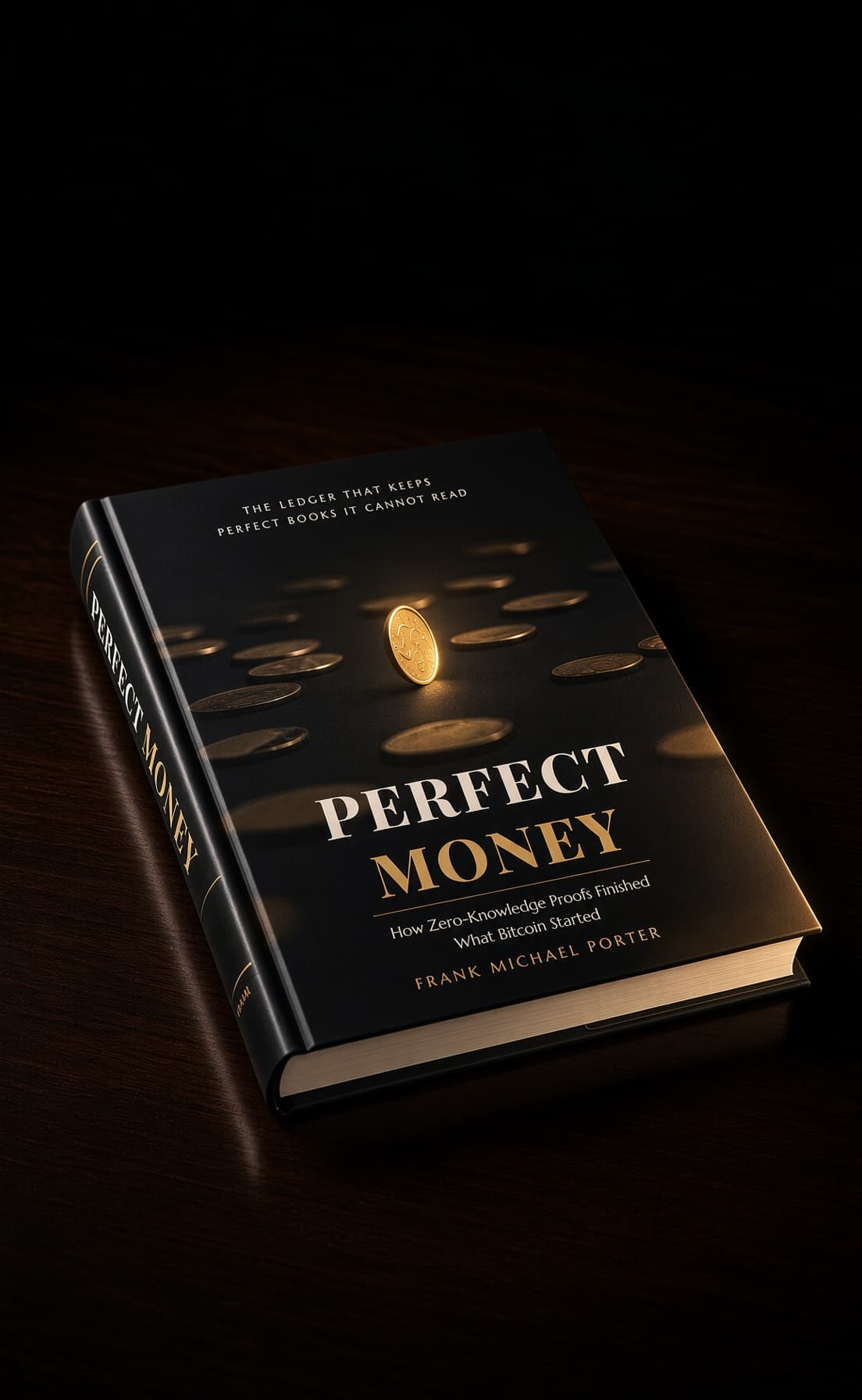
Every civilization that gained the technical capacity to observe its citizens' financial lives used that capacity, without exception. Perfect Money traces the pattern across two thousand years and arrives at Zcash (ZEC), the first real break in it.
The Pattern
Rome counted a life into wax and taxed what it counted. Venice fed a stone lion's mouth with anonymous accusations and built an empire on what the mouth swallowed. East Germany filled a hundred kilometers of shelving with the private lives of its own citizens, mailroom by mailroom, until the state knew its people better than they knew themselves.
The modern financial system finished the job without anyone declaring it finished. A card swipe, a wire transfer, a Bitcoin transaction on the most transparent ledger ever built, each one a small deposit into an archive that never forgets and rarely forgives. Verification and surveillance have always been the same act, wearing different clothes.
The book, in six parts
Part I
The Watched
Part II
The Promise
Part III
The Betrayal
Part IV
The Math
Part V
The Fight
Part VI
Where This Goes
Why This Matters Now
A financial record used to require a human analyst to become dangerous, someone with the time to read it and the authority to act on it. That constraint is gone. A model can now take a transaction history and, in seconds, reconstruct a life: where someone worships, what they medicate for, who they are seeing, what they are planning, all inferred from purchases they never thought of as confessions.
Cash is disappearing on its own schedule, phased out one contactless tap at a time. What is arriving to replace it is being built with an off switch already installed. The question was never going to get less urgent, and the book argues that it is arriving faster than most people have noticed.
“Imagine going to buy a hamburger and the cashier asks you to provide your entire bank statement. Would you still buy the hamburger and eat there?”
Privacy is not about having nothing to hide. It is a constitutional right, one the founding fathers understood before anyone had to explain it to them.
The Proof
In 1985, three mathematicians asked a question no one had thought to formalize: does proving something require showing it? Their answer became the zero-knowledge proof, a way for a network to confirm a claim is true without ever learning what makes it true.
A shielded Zcash transaction uses exactly this. The network confirms that the sender had the funds, that nothing was spent twice, and that the books balance to the penny, all without ever learning who sent it, who received it, or how much moved.
Not hidden from the ledger. Verified by it, and revealed to no one who was not meant to see it. The owner can still choose to show a specific payment to an auditor, a court, or a donor, through a key that unlocks exactly what they choose to unlock and nothing more.
The Answer
Every ledger in this book earned the state's trust by watching. Zcash is the first one that did not need to. It has run for a decade, weathered audits and regulatory pressure, and it is still keeping perfect books it cannot read.
An AI trained on a bank statement no longer needs a warrant, only an address. Zcash was built so that address holds nothing worth reading, and in July 2026 it took the first real step past this cryptography's shelf life. Upgraded shielded notes are now quantum-recoverable: if a quantum computer ever breaks today's elliptic curves, the funds behind them can be recovered rather than stolen outright. Full post-quantum protection is the next stage, targeted for 2027.
This book is the case for why that matters. Not a chart. Not a trade. The first real answer to a pattern two thousand years old.
From the Reviews
“Every government that has ever had the technical capacity to track its citizens' economic activity has used that capacity.”
Paul Brigner - Chief Policy & Regulatory Officer for Zcash Open Development Lab and Georgetown University FinTech Professor
Frank Porter's Perfect Money is an exceptional book.
What impressed me most is its two-thousand-year historical framing. Porter moves from Rome and Venice through East Germany and today's digital financial system to reveal a recurring pattern: once governments and institutions gain the capacity to observe people's economic lives, that capacity expands and is eventually used.
That argument strongly reflects what I have learned through years of policy work. Financial privacy is not a niche feature and should not be treated as inherently suspicious. It is essential to individual freedom, autonomy, association, and dissent. A detailed financial record can reveal far more than spending: it can expose relationships, beliefs, health, movements, and intentions. The book makes a persuasive case that durable privacy must be built into the architecture of money, rather than left to legal or institutional promises that can later be narrowed or withdrawn.
The book is equally strong when it turns to the technology. It explains zero-knowledge proofs in a way nontechnical readers can genuinely understand. Porter begins with intuitive examples but does not stop at a superficial analogy. He carefully explains how a network can verify that a transaction is valid without learning the sender, recipient, or amount. He also shows why Bitcoin's transparent ledger solved decentralized verification while creating a permanent financial record that becomes more traceable over time, and how zero-knowledge proofs can close that gap.
One of the book's most important policy points is that privacy does not come at the expense of accountability. We can build systems that verify transactions without exposing everyone's financial life, while still giving individuals the ability to share relevant information when necessary.
Although Porter has a clear point of view, this is not a trading guide or a marketing brochure. It is a serious, highly readable history of surveillance, cryptography, money, and freedom. I recommend it to policymakers, students, technologists, and anyone thinking about the future of digital money.
It is outstanding and highly recommended.
Perfect Money
Twenty chapters across six parts, from the Roman census to the Snowden archive, from the cypherpunk manifesto to the ceremony that buried a secret on schedule. Narrative nonfiction for a reader with no technical background, rigorous enough that a Zcash policy expert reviewed it favorably.
Paperback
979-8-1870-4118-3
Hardcover
979-8-1870-4124-4
Reviews
5 out of 5 stars
About the Author
Frank Porter started this art business, Lynx, in 2012 with his wife, Nicole, years before most people had heard the word blockchain. The work reached Bitcoin Magazine and Bloomberg, caught the attention of Charles Hoskinson and Andreas Antonopoulos, and ended up on the Ethereum team's own office walls.
He writes nonfiction now, tracing how money and surveillance have leaned on each other for centuries. Perfect Money is his debut book. He is already writing the next one, on how to navigate a life built to surveil you.
Follow Frank on X @lynxcollection
Stay in the loop
Your cart
Your cart is empty.

